Domains
- Death
- Passage of souls
- Eternal calm
Symbols
- Dark wings
- Flickering flame
- Narcissus
Nature and essence
Thanatos is the primordial personification of gentle and inevitable death. Born of Nyx, Night, he belongs to the lineage of abstract powers that structure the human condition. Unlike the Keres, spirits of violent death and slaughter, Thanatos represents peaceful extinction, the final breath that comes without struggle or tearing.
He is not a punishing god: he is a cosmic necessity, a silent presence that marks the natural limit of life.
Place in cosmology
Son of Nyx and twin brother of Hypnos, Sleep, Thanatos embodies continuity with his counterpart: where Hypnos soothes and suspends, Thanatos concludes and releases. This symbolic closeness expresses the Greek idea of a gradual passage from consciousness into darkness.
Ancient texts portray him as an unyielding force, yet devoid of cruelty. Neither gods nor mortals can avoid him, though some heroes may temporarily repel him, such as Heracles who drives him away to save Alcestis.
Role in myths
Thanatos appears rarely, and only as the consequence of a fate already fixed. He is not the instigator of plots but rather the manifestation of a higher law. His presence in narratives underscores the weight of destiny: calm, implacable, and necessary.
In Euripides’ tragedy Alcestis, he is briefly opposed by Heracles, illustrating the rare possibility of defying the natural course of things.
Iconography
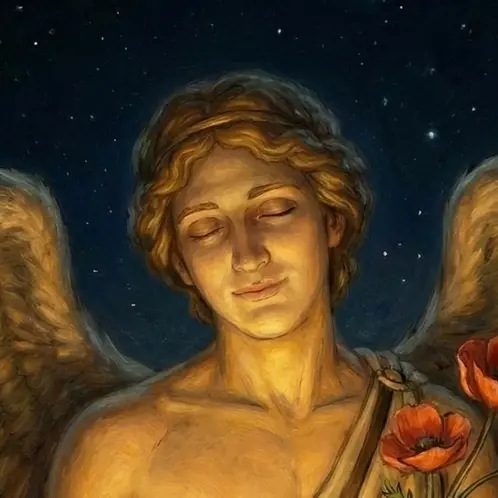
Ancient representations depict him as a winged young man, often of great beauty, sometimes holding an inverted torch symbolizing life extinguished. In funerary art, he appears as a serene guide, far removed from the terrifying imagery associated with violent deaths.
His iconography emphasizes gentleness, dignity, and quiet inevitability.
Detailed genealogy
Open dedicated HoloGraphCentral figure