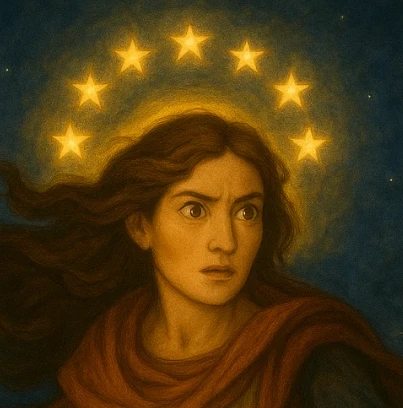
Domains
- Sky
- Endurance
- Cosmic boundary
Symbols
- Celestial globe
- Pillar
- Mountains
Origin and nature
Atlas is the son of the Titan Iapetus and the Oceanid Clymene.
He belongs to a lineage associated with the mortal condition and the tensions
between gods and humans. Among his brothers are Prometheus, Epimetheus, and
Menoetius, each embodying a facet of human fragility or transgression.
Atlas himself represents brute force, the stability that separates sky from earth, a role imposed upon him after the defeat of the Titans.
The condemnation after the Titanomachy
During the revolt of the Titans, Atlas fights against Zeus.
After the defeat, he receives one of the most famous punishments in all of Greek
mythology: he is condemned to bear the celestial vault at the edge of the
world.
This burden does not consist in supporting the Earth, but in separating Sky and Earth, a fundamental cosmic role required to maintain the order of the world.
His punishment symbolizes eternal resistance, endless effort, and the cosmic burden.
Role in narratives
Although he does not often intervene directly, Atlas plays important roles in several traditions:
- Heracles seeks his help to obtain the golden apples of the garden of the Hesperides. Atlas briefly attempts to escape his burden, but Heracles forces him to take the sky back.
- In certain geographical traditions, the Atlas Mountains in Africa are said to be his petrified body, an illustration of his power and his fall.
Through his function, Atlas appears as a boundary figure between the universe of the gods and that of mortals.
Offspring
Atlas is the father of several notable figures:
- the Pleiades, stellar nymphs associated with the constellation of the same name
- the Hesperides, guardians of the garden of golden apples
- sometimes the Hyades, rain nymphs linked to seasonal cycles
Through them, he is connected to celestial phenomena, meteorology, and time.
Iconography
In ancient and modern art, Atlas generally appears in the form of:
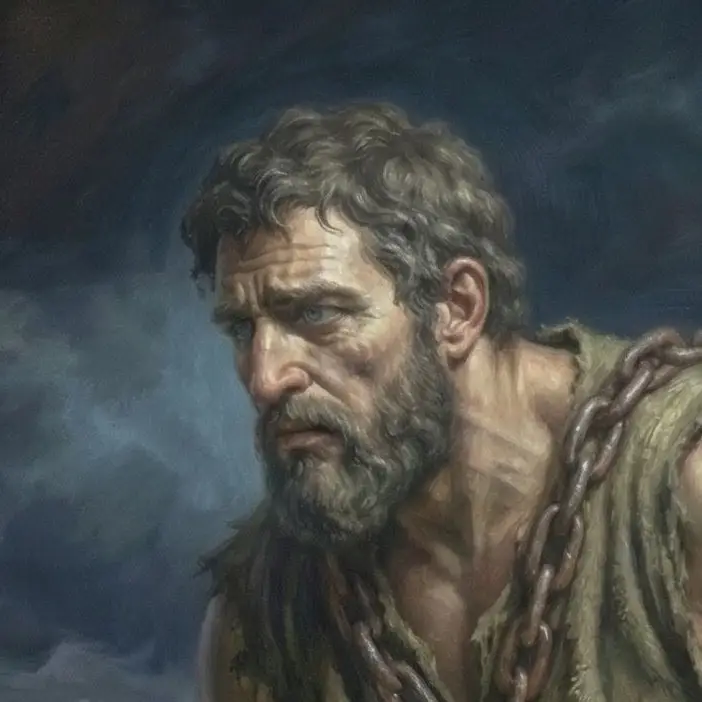
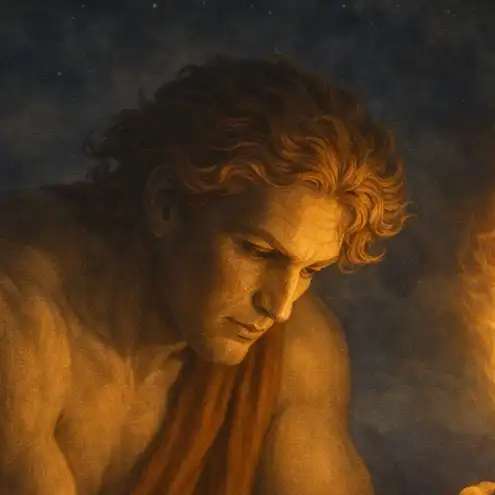
- a gigantic and powerful man
- bent under the weight of a globe or a starry vault
- placed on a rocky promontory or in a wild setting
His iconography always emphasizes the cosmic burden and physical tension, symbols of his function and his condemnation.
Detailed genealogy
Open dedicated HoloGraphCentral figure
Atlas
Parents
3 entries-
Apollodorus · Library · I.2.2
alternative
Siblings
3 entries-
Hesiod ·
retainedApollodorus · Library · I.2.2
alternative
Consorts
1 entry- Pleioneparents of - Pleiades group
Apollodorus · Library · 3.110-111
retainedparents of - Pleiades groupHygin · Astronomica · II.21
alternative
Children
7 entries-
Pleiades
with PleioneApollodorus · Library · 3.110-111
retained