Domains
- Origin of the world
- Primordial abyss
- Cosmic genesis
Symbols
- Void
- Chasm
- Formless night
Nature and essence
Chaos is the primordial entity that emerges at the beginning of the world, before any organization, before any anthropomorphic divinity. It is neither a god nor a personified force in the classical sense, but a state of being: an indistinct gaping void, an open and formless space that makes existence possible.
In Greek cosmology, Chaos is not conflicting disorder: it is the interval, the creative void, the prerequisite condition for all emergence. It marks the absolute beginning of the cosmogonic narrative.
Offspring and cosmic role
From Chaos are born several fundamental entities, according to the traditions:
- Nyx (Night),
- Erebus (Darkness),
- sometimes Gaia (Earth) according to certain interpretations,
- and, by extension, the lineages that will structure the universe: light, day, vital and destructive forces.
Chaos governs nothing and does not intervene in narratives, but its presence is indispensable: it is the point of origin from which everything proceeds, even the most ancient gods.
Place in mythological traditions
Ancient authors use Chaos to express absolute anteriority. Hesiod makes it the first being to emerge, preceding Gaia, Tartarus, and Eros. Other traditions see Chaos not as an individual but as an initial cosmic state.
This ambiguity, entity or concept, is part of its very nature: Chaos occupies the boundary between nothingness and creation.
Iconography
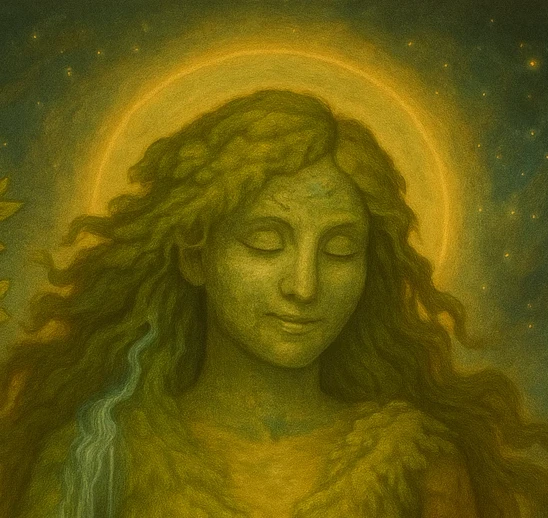
Chaos is rarely represented, as it transcends form. When it appears visually, it is often in the form of an abyss, a formless night, or an abstract cosmic silhouette evoking the indistinct immensity of the first world.
Detailed genealogy
Open dedicated HoloGraphCentral figure
Chaos
Parents
2 entries-
Orphic texts · Orphic fragments
alternative
Siblings
3 entries- Cosmos
Orphic texts · Orphic fragments
alternative -
Orphic texts · Orphic fragments
alternative - Moirai
Orphic texts · Orphic fragments
alternative