Domains
- Strength
- Trial
- Purification
- Protection
Symbols
- Club
- Lion skin
- Bow
- Brute force
Origin and identity
Heracles is born from the union of Zeus and Alcmene, a mortal woman of the line of Perseus. Yet this birth is double and profoundly asymmetrical. On the same night, Alcmene conceives two children: Heracles, fathered by Zeus who has taken the appearance of Amphitryon, and Iphicles, born of the real Amphitryon.
The two boys are thus twins by their mother, but not by their father. They grow up together, share the same household, but from the outset embody two distinct natures: one bears a latent divine power, the other remains fully human.
This asymmetrical twinship makes the singularity of Heracles immediately visible and fuels the hatred of Hera, wife of Zeus. By pursuing the divine child with her resentment, the goddess attacks not only Zeus’s adultery, but also this genealogical anomaly that she cannot prevent.
His very name, Heracles, means “glory of Hera”: a cruel irony, since the hero’s entire existence will be shaped by the trials imposed by the goddess, repeated attempts to break or humiliate the one who embodies, despite her, her own glorification.
An extraordinary strength, a constrained destiny
Endowed with exceptional strength from childhood, Heracles does not for all that become a free hero. Struck by a fit of madness sent by Hera, he kills his wife Megara and their children. This irreparable act marks a foundational rupture in his existence.
To atone for this crime, he submits to the authority of King Eurystheus, who imposes upon him a series of ordeals intended to destroy him: the Labors of Heracles.
The labors: mastered violence and purification
The labors are not mere physical exploits. They constitute a path of purification:
- confronting chaotic or monstrous forces,
- cleansing what the world refuses to look at,
- restoring a viable order between humans, nature, and the divine.
Heracles fights primordial beasts, confronts death, descends into the Underworld, and crosses the confines of the known world. Each trial expands his sphere of action and his mythological stature.
An ambivalent hero
Heracles is neither wise nor measured. He is excessive, hot-tempered, sometimes cruel. His greatness lies in his ability to endure the unendurable and to act despite suffering.
He constantly oscillates:
- between humanity and divine power,
- between destruction and protection,
- between moral fault and cosmic necessity.
This ambivalence distinguishes him from the Olympian gods and explains his enduring popularity among mortals.
Death and apotheosis
The end of Heracles is marked by the ruse of Deianira and the poison of Nessus. Consumed by a tunic soaked in venom, he chooses to mount a funeral pyre, fully accepting his mortal end.
But this death is not annihilation. Zeus raises him to Olympus and grants him apotheosis. Heracles becomes immortal and is even reconciled with Hera, symbolically sealing the end of his cycle of suffering.
Mythological significance
Heracles is a central figure of Greek mythology:
- he embodies the civilizing hero,
- he links the world of humans with that of the gods,
- he shows that greatness is achieved through ordeal and reparation.
His myth affirms that strength has value only when placed in the service of a greater order, even at the cost of individual suffering.
Iconography
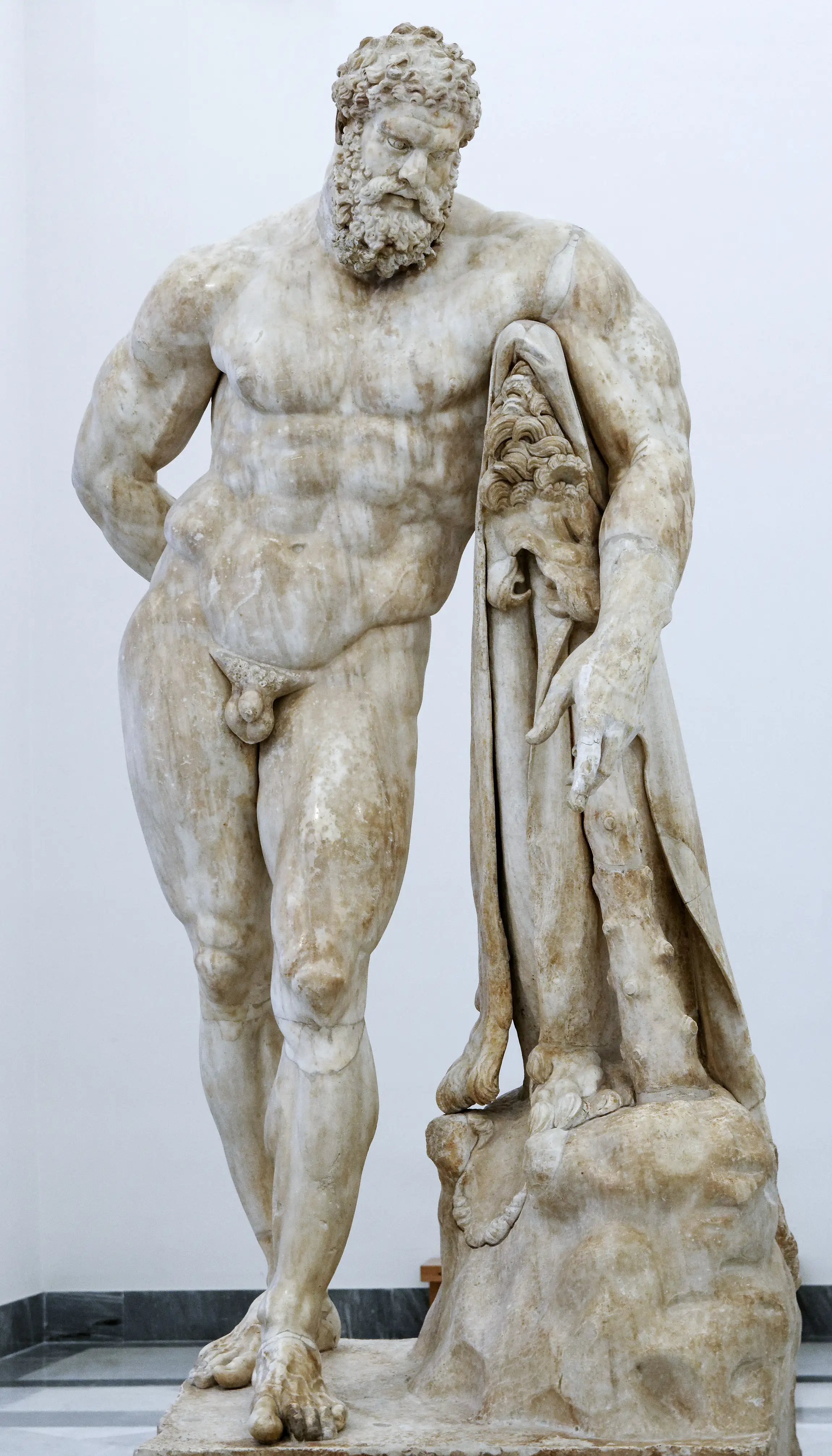
Heracles is one of the most frequently represented figures of Antiquity:
- a powerful and disproportionate body,
- the skin of the Nemean lion draped over his shoulders,
- the club as a primitive weapon,
- sometimes the bow and poisoned arrows.
His iconography emphasizes the tension between brutality and heroism, making him an immediately recognizable and timeless figure.
Detailed genealogy
Open dedicated HoloGraphCentral figure