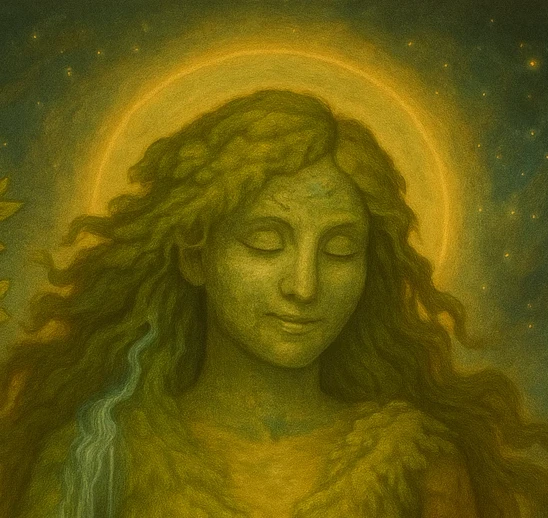
Domains
- Mountains
- Earthly forces
- Primordial nature
Symbols
- Rocks
- Peaks
- Eternal snow
Nature and origin
The Ourea are the primordial deities of the mountains.
According to Hesiod, they are born from Gaia alone, at the same time as
Ouranos (the Sky) and Pontos (the Sea). They embody the immense and abrupt
reliefs that emerge as the Earth takes shape and becomes structured.
They are neither Olympian gods nor Titans: they are elemental forces, living personifications of the mountains themselves.
Identity and function
Each Ourea corresponds to a specific peak or mountain range. Among the most well known in mythological tradition are:
- Othrys, the original dwelling place of the Titans,
- Haemonion,
- Nysa, the sacred mountain associated with the myth of Dionysos,
- Ida, present in various Cretan and Phrygian myths.
They do not possess strong narrative individuality: their existence is primarily cosmological. They represent stability, natural boundaries, and sacred places where many myths unfold (divine births, retreats, secret cults).
Mythological role
The Ourea rarely appear as characters in narratives. Their role is to form the physical framework of the world:
- places of birth (such as Zeus on Cretan Ida),
- refuges for deities and heroes,
- sacred spaces associated with ancient cults,
- boundaries between the human and divine realms.
They belong to the infrastructure of myth rather than to its action.
Symbolism
The Ourea embody:
- the immutability of the world,
- the permanence of territory,
- sacred verticality,
- the link between Earth and Sky.
Geographical measures turned into divinities, they remind us that Greek mythology never separates landscape from theology: mountains are powers.
Iconography
They are very rarely represented in ancient art. When they are, they take the form of:
- massive male figures emerging from rock,
- or silhouettes fused with the mountain itself.
Their appearance is always mineral, stable, and imposing.
Detailed genealogy
Open dedicated HoloGraphCentral figure
Ourea
Parents
1 entry-
Hesiod ·
retained