Domains
- Sun
- Light
- Vision and revelation
- Daily cycle
- Truth
Symbols
- Solar chariot
- Fiery horses
- Sun disk
- Radiant crown
Identity and Essence
Helios is the personification of the Sun in the archaic Greek tradition. Son of the Titan Hyperion and Theia, brother of Selene the Moon and Eos the Dawn, he belongs to the generation of luminous powers born in the age of the Titans. Even before the rise of Apollo as a solar god in certain later traditions, Helios embodies the Sun as a visible, constant, and unfailing cosmic reality.
He is not merely a deity associated with light: he is the light itself in its daily movement. Each day, he crosses the sky from east to west in his blazing chariot, drawn by fiery horses, then returns to the East during the night to begin again his eternal course.
Cosmic Function
Helios’ role is first and foremost cosmological. His course governs the rhythm of the visible world: the alternation of day and night, the measure of time, the succession of seasons in relation to other powers. He illuminates the earth, the seas, and the cities, revealing all that takes place beneath his light.
This omnipresence makes him a universal witness. Nothing escapes the gaze of Helios. In many myths, he reveals to the gods actions hidden from mortal eyes. It is he, for example, who informs Demeter of the abduction of Persephone, for he saw the scene from the sky. His light is therefore also a light of truth.
Offspring and Lineages
Helios fathers several significant figures. With the Oceanid Perseis, he is the father of Circe, the formidable enchantress, Aeetes, king of Colchis, and Pasiphae, future queen of Crete. Through these lineages, his solar radiance extends into myths marked by magic, royalty, and transgression.
His most famous son is Phaethon, born from his union with the nymph Clymene according to certain traditions. Phaethon, eager to prove his divine lineage, obtains permission to drive the solar chariot. Unable to master the fiery horses, he loses control, threatens to set the earth ablaze, and must be struck down by Zeus to prevent catastrophe. This myth underscores the dangerous power of celestial fire and the unbridgeable boundary between divine and human condition.
Cult and Representation
Helios received particular worship on the island of Rhodes, where he was honored as the principal protector. Tradition holds that the famous Colossus of Rhodes, a gigantic bronze statue erected at the entrance of the harbor, represented the solar god in all his majesty.
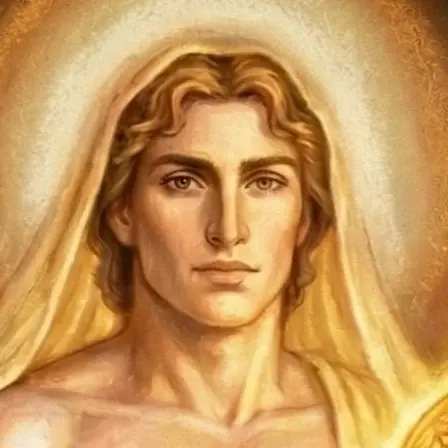
In ancient iconography, he appears as a radiant young man, often crowned with rays of light. His chariot, his blazing horses, and the solar disk are among his most frequent attributes. The imagery emphasizes movement, regularity, and controlled power.
An Enduring Archaic Figure
With the rise of the cult of Apollo, certain solar functions tended to overlap. However, Helios did not disappear. He remained the cosmic personification of the Sun, distinct from the oracular and artistic Apollo. This coexistence reflects the complexity of Greek tradition, in which several figures may embody complementary aspects of the same reality.
Helios thus represents visible light, universal surveillance, and the stability of the daily cycle. An ancient power born of the Titanic order, he endures across divine generations without losing his fundamental role: to remind that the world, under the clarity of daylight, is always exposed to truth.
Detailed genealogy
Open dedicated HoloGraphCentral figure