
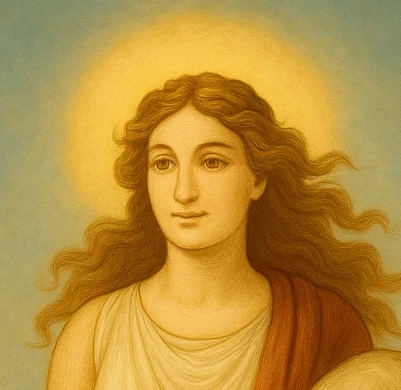

A nurse whose name carries destiny
Among the discreet figures who watch over Zeus as a child, Adrasteia holds a singular place. Her name is not incidental. Derived from Adrásteia, it means “she from whom one cannot escape.” Even before her actions, her identity announces a fundamental truth: destiny is already at work.
Adrasteia is not a heroine of spectacular deeds. She confronts no enemy, utters no resounding prophecy. She is presence. A constant, silent, almost effaced presence, yet essential. In the shadow of the Cretan cave, she embodies long duration, the time in which powers are formed before revealing themselves.
Watching over a child promised to the world
In the cave of Mount Ida, Zeus is still a vulnerable infant, hidden from the fury of Cronus, his father, devourer of his own children. Adrasteia watches over him not only to ensure his survival, but to preserve the fragile balance between protection and growth.
Raising Zeus does not simply mean hiding him. He must be fed, soothed, allowed to grow without attracting the attention of hostile forces. Adrasteia embodies this constant vigilance, this attention to every gesture, every sound, every silence. Her role is to keep the child alive without hastening his emergence.
Learning measure before power
Adrasteia does not transmit laws or commandments. She teaches differently, through regularity, through the repetition of simple gestures, through a form of daily discipline. Through her, Zeus learns that power is not born from excess, but from mastery.
Within this protected childhood, the future sovereign discovers an ordered, rhythmic world in which nothing is left to chance. Adrasteia thus becomes an educational figure in the deepest sense: she shapes a god capable of patience, a rare quality in a pantheon often ruled by impulse and anger.
Destiny is not escape
Adrasteia knows that Cronus will fall. She seeks neither to hasten the prophecy nor to divert it. Her role is not one of trickery or deception, but of rightful waiting. She ensures that time itself accomplishes its work.
In this, she embodies an essential Greek conception of destiny: the inevitable is not confronted head-on, it is prepared. Zeus’s future victory depends as much on the thunderbolt to come as on those silent years when nothing must happen too soon.
Stepping aside when the hour comes
When Zeus leaves childhood and sets out to confront his father, Adrasteia disappears from the narratives. She accompanies neither the Titanomachy nor the establishment of Olympian order.
Her task is complete: she has protected, formed, restrained. She withdraws at the precise moment when destiny can finally manifest without restraint. This disappearance is not oblivion, but the fulfillment of her function.
The legacy of a silent figure
Adrasteia reminds us that in Greek mythology, the most decisive forces are not always the most visible. Before the thunderbolt, there is waiting. Before sovereignty, there is education. Before the inevitable, there are those who ensure that it unfolds without chaos.
Thus, before becoming the god of justice and thunder, Zeus was a child raised by a figure whose very name proclaimed that no one, not even a Titan, can escape what must come to pass.