
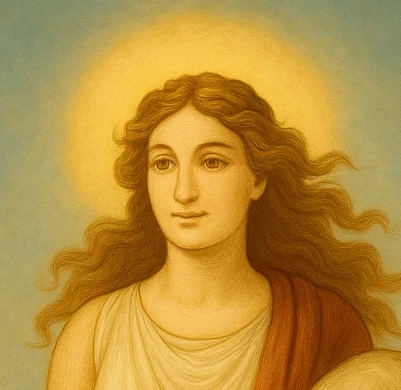

The silent guardian of the hidden child
When Zeus is born in Crete, snatched from Cronus’ devouring fate through Rhea’s stratagem, he is entrusted not to the gods but to the humble and ancient forces of the earth. Among them stands Melissa, a discreet mountain nymph, older than temples, more faithful than oaths.
She watches over the child hidden within a cave on Mount Ida. While the Corybantes drown his cries with their martial dances, Melissa provides what no one else can offer: nourishment that is gentle, pure, and silent. She feeds Zeus with honey, a rare, solar, incorruptible substance.
A secret guarded more closely than gold
Cronus suspects that the child has escaped his fate. He questions nymphs, shepherds, and mountain spirits. Melissa, too, is interrogated.
She knows that Zeus’ survival depends on silence. She endures pressure, threats, sometimes violence, yet reveals nothing. The divine secret is more precious than her own life.
In some traditions, Cronus punishes her for her refusal. He strikes or maims her. In others, the gods themselves test her fidelity. Whatever the version, Melissa does not speak.
The metamorphosis
When the danger recedes and Zeus grows beyond his father’s reach, the nymph vanishes. The traditions differ on the exact moment, but all agree on the outcome.
Melissa is transformed into a bee.
Her body becomes light, her voice a hum, her gestures an unceasing, patient labor. She retains her function: to protect, to nourish, to transmit without noise.
A reward disguised as disappearance
Melissa’s metamorphosis is not a simple punishment. She is neither destroyed nor condemned. She is absorbed into a wider order.
Bees become sacred. Honey is henceforth associated with the gods, with oracles, with the dead, and with initiation. In certain cults, priestesses guard ritual secrets, just as the nymph once guarded the secret of the young Zeus’ presence.
The legacy of an invisible act
When Zeus ascends to kingship, few remember Melissa. Her name is not sung in great epics. Yet without her, the king of the gods would not have survived.
Thus Melissa embodies another form of power: the one that acts in shadow, protects without glory, and transmits without imposing itself.
Her metamorphosis seals an ancient truth: in Greek mythology, the most decisive forces are often the most silent.