
A threat that listens
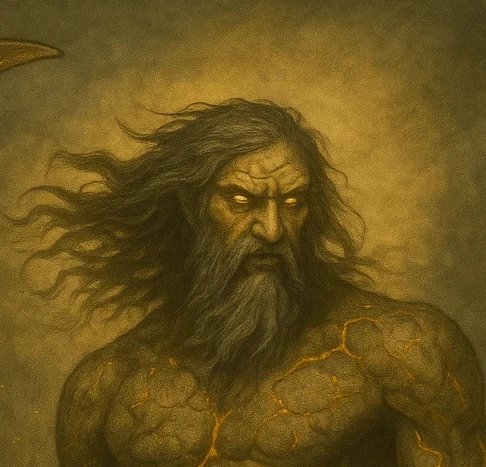
Even hidden within a Cretan cave, Zeus is never beyond danger. Cronus does not see everything, but he listens. The world reaches him through vibrations, rumblings, echoes. The slightest cry, the faintest wail could betray the existence of the child he believes he has destroyed.
Rhea understands that Zeus’s survival depends not only on shadow, distance, or deception, but on sound. As long as the child’s voice can be heard, the secret remains fragile.
The invention of a sonic protection
Around the cave of Mount Ida gather the Corybantes, warrior-ritual figures standing at the threshold between soldiers and sacred officiants. Helmeted and armed with spears and shields, they do not come to wage war, but to establish an unprecedented form of defense.
Their mission is not to defeat a visible enemy, but to divert the attention of a cosmic force. They spread out around the cave and strike their weapons against one another without pause. Metal resounds, blows follow blows, and a continuous clamor rises through the mountain.
Noise as a rampart
When Zeus cries, his voice is immediately swallowed by the clash. The noise does not erase the fragile sound of the child, it drowns it. The uproar becomes a screen, an invisible wall raised against the listening of Cronus.
This gesture is not improvised. The armed dance of the Corybantes follows a strict, repetitive rhythm, almost hypnotic. Each strike answers the last. Each movement fits within a controlled cadence. What appears as chaos is in truth disciplined order.
Thus Zeus’s silence is not achieved through the absence of sound, but through its excess. Sonic tumult becomes an instrument of protection.
The birth of a rite
The dance of the Corybantes quickly surpasses its immediate function. It enters a broader register, that of ritual. The uproar becomes sacred, the repeated gesture acquires religious meaning.
Later, in Crete and elsewhere in the Greek world, such armed dances are re-enacted. They serve to drive away hostile forces, to protect children, to mark delicate transitions between order and disorder. The myth thus provides a sacred origin for real cultic practices.
It teaches that noise can uphold order, and that collective trance can safeguard the stability of the world.
The strength of the group
Unlike Amalthea or Melissa, solitary figures of care and nourishment, the Corybantes act in collectivity. Their effectiveness rests not on a single hero, but on perfect coordination.
They embody an anonymous, sacrificial form of protection. Each dissolves into the shared rhythm, none seeking recognition. Their power lies in repetition, synchronization, the erasure of the ego within the rite.
This collective defense already foreshadows a principle of the coming Olympian order: stability is not sustained by one force alone, but by harmony among many acting together.
The echo of a founding clamor
When Zeus leaves the cave and moves toward his destiny, the Corybantes withdraw. Their task is complete. The time of concealment ends as the time of confrontation approaches.
Yet their gesture endures. In every armed dance, in every loud rite meant to repel evil, protect the sacred, or ward off an unseen threat, their echo still resounds.
Thus the future king of the gods owes his survival not only to cunning and nurture, but also to ritualized noise, guardian of destiny before the thunderbolt ever spoke.