A place withdrawn from sight
On the slopes of Mount Ida in Crete opens a cave without splendor, without temple and without altar. It is neither palace nor sanctuary in its origin. It bears no sign of power or divine consecration. It is a refuge, carved into rock, hidden from the gaze of gods and mortals alike.
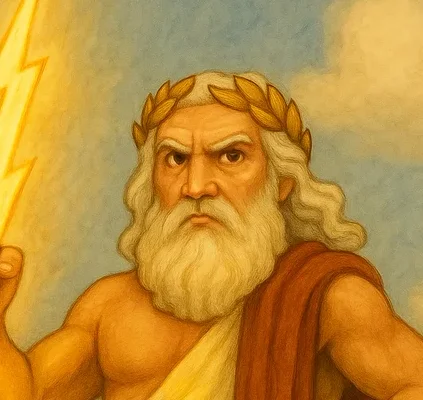
There Zeus is concealed. Not in the celestial heights, but in the depths of the earth. Before becoming the god of the sky and lightning, the future sovereign is entrusted to what is most ancient: stone, shadow and silence.
The cave as the womb of the world
The cave of Mount Ida is not a simple backdrop. It functions as a matrix: it envelops, protects and delays. Time seems suspended there, as if the world itself were holding its breath.
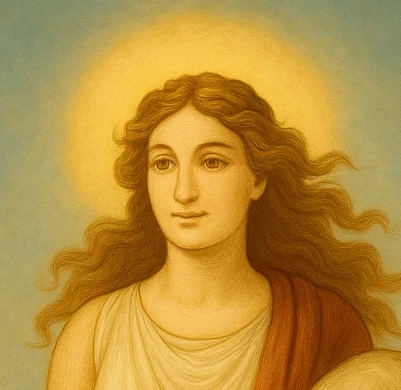
Within this enclosed space converge all the forces necessary for the child’s survival. Rhea’s stratagem finds refuge there. The vigilance of the nymphs remains. The ritual clamor of the Corybantes covers his cries. Amalthea offers sustenance. Melissa guards in silence. Adrasteia embodies patient waiting.
The cave does not distinguish between these forces. It receives them all, gathers them, holds them in balance, and thus becomes the place where scattered gestures form a coherent whole.
Growing away from the light
Zeus grows far from Olympus and the sky he will one day rule. His education unfolds in shadow, in contact with rock, milk, honey and the rhythm of armed dances.
This subterranean childhood marks his relation to the world. The future king first learns dependence, patience and restraint. He is not immediately sovereign, but hidden and vulnerable, shaped by waiting. The power he will later wield is prepared in concealment, not in display.
A place older than reigns
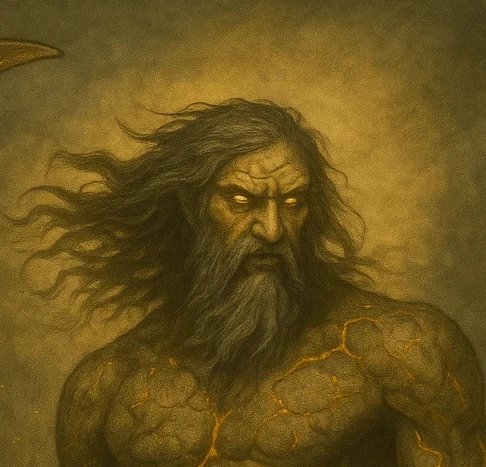
Unlike divine palaces and celestial thrones, the cave of Mount Ida belongs to no reign. It precedes Uranus, Cronus and Zeus himself. It belongs to the earth, a force older than divine succession.
In that sense it takes no side, choosing neither Titan nor Olympian. It simply offers a space where destiny may unfold without interruption. The cave imposes nothing: it allows.
From refuge to sacred site
When Zeus leaves the cave and turns toward confrontation with his father, the place loses its immediate function as refuge, yet it does not vanish.
The cave becomes sacred. Cults arise there. It is recognized as the point of origin of Olympian order. Not the site of victory, but of preservation. Where violence was deferred, the world was able to transform without collapsing.
Closing of the cycle
The cycle of Zeus’s childhood ends here. Not with battle, nor with a dazzling revelation, but with a silent departure. The god leaves the place that sheltered him, and the cave remains.
It does not directly create his reign. But it makes it possible. It is the place where time was gained, where confrontation was delayed, where future order was allowed to mature.
Thus, before lightning struck and the Titans fell, there was a cave, dark and silent, that allowed the future king of the gods to become what he was meant to be.