
The king and the order
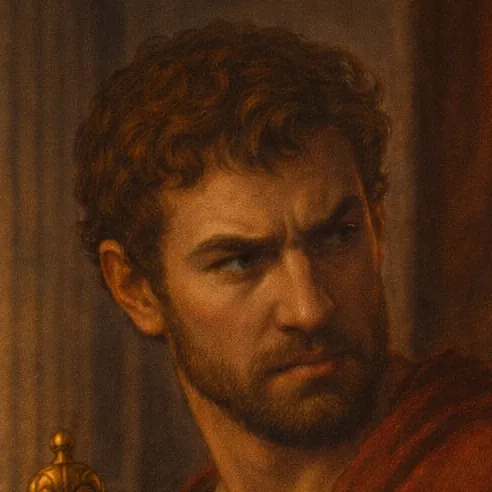
Dionysus does not arrive in Thebes as a conqueror - he arrives as a rumor. Women leave the city to dance in the mountains; chants rise through the night. New rites spread beyond the walls. For Pentheus, king of Thebes, these practices are a direct threat: they defy authority, unsettle the city, and blur the line between order and chaos.
Pentheus has no doubts: he flatly refuses to recognize Dionysus as a god. In his eyes, the newcomer is nothing but an impostor, a corruptor come to sow disorder and confusion. By banning his cult, Pentheus believes he is defending law, measure, and stability. What he fails to grasp is that he is standing against a divine power.
The masked god
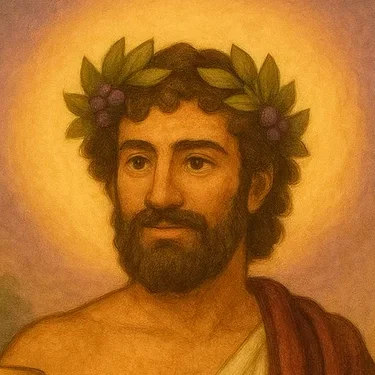
Dionysus presents himself to Pentheus in the guise of a stranger. He threatens no one, forces nothing. He watches, he speaks. Above all, he lets the king seal himself inside his own certainties. The more Pentheus asserts his authority, the more Dionysus lays bare the cracks in his power.
The king has the stranger arrested, chained, and humiliated. But the chains break, the doors open, the prison holds nothing. Dionysus has no need to escape - he was never truly captive. Pentheus’s order is revealed for what it is: powerless, unable to contain what it cannot understand.
Fascination and the fall
Gradually, the refusal begins to fracture. Pentheus wants to see, wants to understand what is happening on the mountain. This curiosity is not a search for truth - it is a temptation, one nurtured by Dionysus himself. The god leads the king to transgress his own prohibitions, to disguise himself, to cross the very boundaries he once imposed on others.
What was meant to be an act of control becomes a total loss of bearings. Pentheus no longer watches from within the city - he steps of his own accord into the rite he once despised. He ceases to be a king and becomes the object of another’s gaze.
The dismemberment
On Mount Cithaeron, in the grip of collective trance, Pentheus is no longer recognized. The women, seized by sacred fury, see him as prey. The violence breaks loose. The king is torn to pieces. His own mother, Agave, takes part in the dismemberment - without recognizing her son.
The death of Pentheus is not a simple punishment: it is the logical end of a refusal. In denying Dionysus, he denied the part of shadow, loss, and transformation that is inherent to reality. And so that part returns - but without measure.
A justice without appeal
The justice of Dionysus is carried out without visible anger. The god did not strike with his own hands; he simply let refusal play out its own logic to the end. The order Pentheus believed he was defending turned against him.
In Thebes, power is shattered, the bloodline destroyed, and the true meaning of the transgression becomes clear only too late. To refuse Dionysus is not to reject a cult: it is to refuse a fundamental truth of the world.
And so the heart of the Dionysiac cycle is fulfilled: where order closes itself off, the god breaks through - and the rupture becomes irreversible.